
Air Pollution

Delhi woke up to a hazy morning on November 6, 2025 as a thin layer of smog blanketed the city, with the AQI at 278 in the ‘poor’ category and likely to deteriorate to the ‘very poor’ range by evening, according to the forecast.


UPSC MAINS SYLLABUS RELEVANCE:    GS 3:      

conservation, environmental pollution and degradation, environmental impact assessment.”


ABOUT AIR POLLUTION:

Definition: Air pollution is the presence of substances in the atmosphere—such as gases, particulates, or biological molecules—in quantities that are harmful to human health, living organisms, or cause damage to the natural environment and built structures.


CAUSES OF AIR POLLUTION IN INDIA:
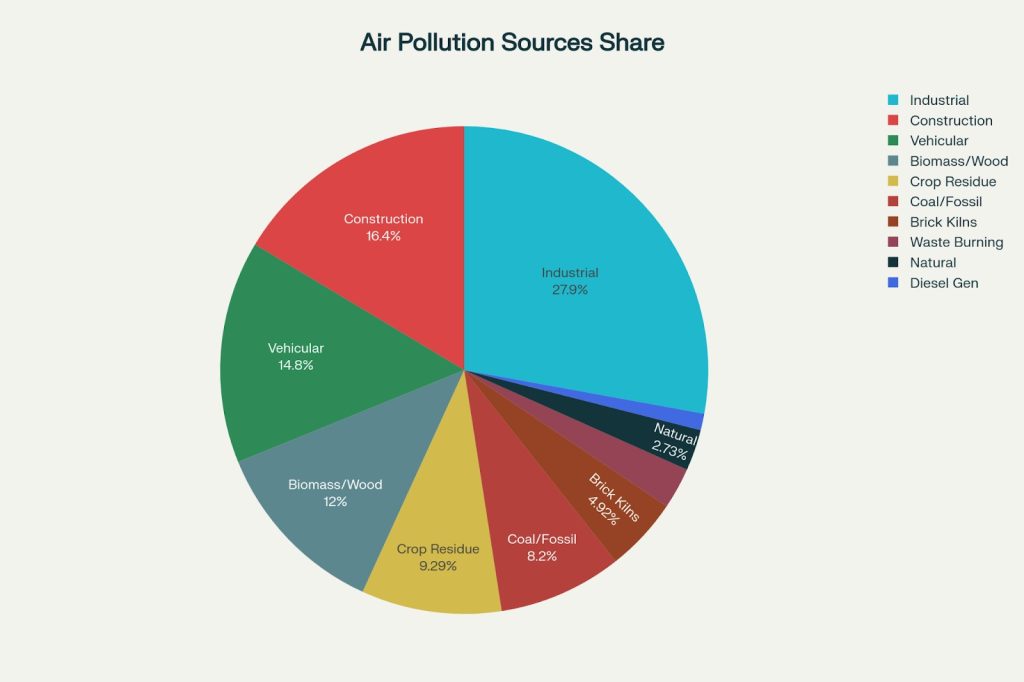
  1. Industrial emissions: major pollutants released include sulphur dioxide, nitrogen oxides and particulate matter. 
    • Contributes to 51% of overall air pollution.
    • Major cities: Delhi, Ghaziabad and Bhiwadi.
  2. Vehicular emissions: Motor vehicles (cars, trucks, two-wheelers, etc.) emit nitrogen oxides, carbon monoxide, hydrocarbons, and particulate matter.
    • contributes : 27% of overall pollution.
    • Major cities impacted are delhi , mumbai, kolkata, chennai and bengaluru.
  3. Crop residue burning: Burning to clear the stalks of paddy after kharif season, to prepare for rabi season majorly in northern India contributes to autumn- winter season pollution. 
    • Majorly in the northern india and northwest region including delhi, punjab and haryana 
    • Contributes around 17% of the total pollution.
  4. Biomass and fuel wood burning: Rural and Urban households using fuelwood and dung cakes for cooking and heating releases particulate matter and smoke.
    • Contributes around 22 to 50 % of total PM 2.5 in India, with very high presence in rural India.
    • It is the leading cause of household air pollution in India. 
    • Varanasi the city majorly impacted by fuelwood burning.
  5. Construction activities and road dust: Particulate matter released from urban construction sites and roads. Asphalting of roads is also a major cause of pollution
    • Percentage: Up to 30–37% of PM emissions in cities.
    • All urban cities of India.
  6. Use of coal and other fossil fuels: Majorly used in thermal power plants and in Iron and Steel industries 
    • Percentage: significant part of industrial share
    • Major City: Dhanbad (Jharkhand – mining/power), also Delhi
  7. Diesel generator sets: They are predominantly used for agricultural activities and also in urban areas during power outages.
    • Percentage: Small, but locally high in NCR: National Capital Region.
    • Major City: Gurgaon (frequent power outages)
    • Major rural areas with predominance of irrigation in agriculture.
  8. Brick kilns and small scale industries: Technologically inefficient systems used in these industries lead to persistent air pollution in the surrounding regions.
    • Percentage: Significant locally, differs across states.
    • Major City: Ghaziabad, Bhiwadi, Faridabad
  9. Open burning of garbage and solid waste mainly in cities with population more than 1 crore.
    • Percentage: around 5%
    • Major City: Kolkata (also widespread in Delhi, Bengaluru)
  10. Natural causes like dust storms, forest fires, volcanic eruptions also are seasonal contributors to air pollution in the surrounding areas of their occurrence.
    • Percentage: Seasonally variable (~5% or less)
    • Major City: Jaipur (dust storms), Delhi (affected by regional winds).
    • Uttarakhand, Odisha, Mizoram and Chhattisgarh are highly impacted by forest fires, with presence of significant hotspots.

ALL POSSIBLE CONTRIBUTING FACTORS FOR  DELHI’S SMOG AND DETERIORATING AIR CONDITIONS EVERY YEAR

  1. Stubble Burning: Farmers in neighbouring states (Punjab, Haryana, UP) burn crop residue, releasing massive smoke and particulate matter that winds carry to Delhi, intensifying smog.
  2. Vehicular Emissions: Delhi’s vast vehicle fleet (cars, trucks, buses) emits NOx, CO, PM2.5, and VOCs; winter holidays increase traffic and pollution.
  3. Construction/Road Dust: Ongoing construction and heavy traffic stir up dust and debris, which remains suspended in the cool winter air, significantly boosting particulate pollution.
  4. Industrial Emission: Factories in and around Delhi release pollutants (SO2, particulate matter), a problem exacerbated by poor air circulation.
  5. Firecracker Use: Diwali celebrations cause short-term spikes in toxic smog due to the release of chemicals and fine particles.
  6. Domestic Fuel Use: Use of fuelwood, charcoal, or kerosene in some households, particularly low-income areas, emits trapped smoke and particulates in winter.
  7. Coal Power Plants: Though reduced, power plants near NCR contribute particulate and gaseous pollution, especially in stagnant winter air.
  8. Population Density: Delhi’s massive population causes high baseline emissions from vehicles, heating, cooking, and commerce.
  9. Resuspended Dust: Dry soil and urban surfaces stirred up by traffic after the monsoon raise PM10 and PM2.5 levels.
  10. Secondary Particle Formation: Atmospheric chemical reactions involving NOx, SOx, ammonia, and VOCs form secondary particulates, worsening smog.
  11. Lack of Green Cover: Reduced vegetation lessens pollutant absorption, leading to air stagnation and high concentrations.
  12. Indoor Air Pollution: Poor ventilation and increased indoor heating/cooking can contribute to outdoor pollution in winter.
  13. Poor Waste Management: Open decomposition or burning of uncollected waste releases toxic fumes and gases.
  14. Diesel Generator Sets: Increased use during winter power outages emits particulates and NOx locally.
  15. Regional Transboundary Pollution: Pollutants from neighbouring states (industry, burning) are transported to Delhi by prevailing winds.
  16. Weather Factors: Occasional dust storms (e.g., from Rajasthan) and dry spells worsen already poor air quality.

ROLE OF WESTERN DISTURBANCES AND DELHI’S GEOGRAPHY AS CONTRIBUTING FACTORS TO THE AIR POLLUTION PROBLEM
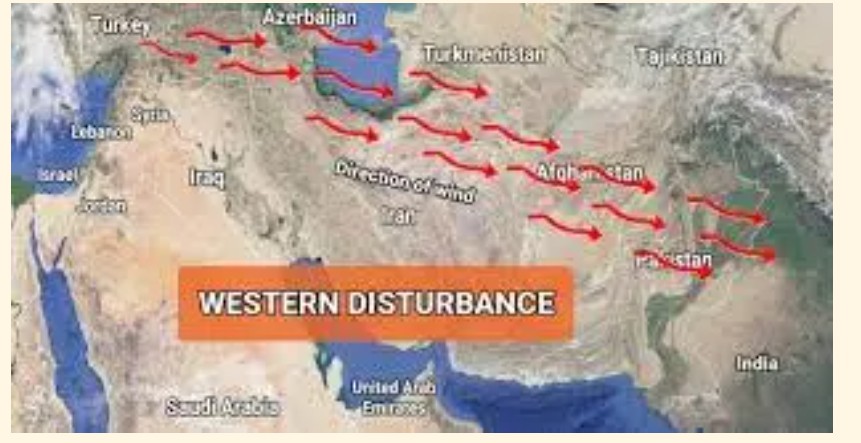
  • Role of western disturbances:
    • The arrival of western disturbances with light rain can actually bring relief to Delhi’s polluted air, by removing airborne pollutants.
    • However when western disturbances pass, it is followed by clear skies and calm winds promoting dense fog formation. This combined with trapped smoke and particulates creates episodic smogs and worsened air quality with poor visibility.
  • Role of Delhi’s geography 
Delhi is located in a natural bowl basin in the midst of Aravallis and Himalayas. This causes temperature inversion during winter, causing cold air with high pressure on the ground, which confines pollutants to accumulate near the surface.

ALL POSSIBLE CONTRIBUTING FACTORS FOR  DELHI’S SMOG AND DETERIORATING AIR CONDITIONS EVERY YEAR

  1. Stubble Burning: Farmers in neighbouring states (Punjab, Haryana, UP) burn crop residue, releasing massive smoke and particulate matter that winds carry to Delhi, intensifying smog.
  2. Vehicular Emissions: Delhi’s vast vehicle fleet (cars, trucks, buses) emits NOx, CO, PM2.5, and VOCs; winter holidays increase traffic and pollution.
  3. Construction/Road Dust: Ongoing construction and heavy traffic stir up dust and debris, which remains suspended in the cool winter air, significantly boosting particulate pollution.
  4. Industrial Emission: Factories in and around Delhi release pollutants (SO2, particulate matter), a problem exacerbated by poor air circulation.
  5. Firecracker Use: Diwali celebrations cause short-term spikes in toxic smog due to the release of chemicals and fine particles.
  6. Domestic Fuel Use: Use of fuelwood, charcoal, or kerosene in some households, particularly low-income areas, emits trapped smoke and particulates in winter.
  7. Coal Power Plants: Though reduced, power plants near NCR contribute particulate and gaseous pollution, especially in stagnant winter air.
  8. Population Density: Delhi’s massive population causes high baseline emissions from vehicles, heating, cooking, and commerce.
  9. Resuspended Dust: Dry soil and urban surfaces stirred up by traffic after the monsoon raise PM10 and PM2.5 levels.
  10. Secondary Particle Formation: Atmospheric chemical reactions involving NOx, SOx, ammonia, and VOCs form secondary particulates, worsening smog.
  11. Lack of Green Cover: Reduced vegetation lessens pollutant absorption, leading to air stagnation and high concentrations.
  12. Indoor Air Pollution: Poor ventilation and increased indoor heating/cooking can contribute to outdoor pollution in winter.
  13. Poor Waste Management: Open decomposition or burning of uncollected waste releases toxic fumes and gases.
  14. Diesel Generator Sets: Increased use during winter power outages emits particulates and NOx locally.
  15. Regional Transboundary Pollution: Pollutants from neighbouring states (industry, burning) are transported to Delhi by prevailing winds.
  16. Weather Factors: Occasional dust storms (e.g., from Rajasthan) and dry spells worsen already poor air quality.

ROLE OF WESTERN DISTURBANCES AND DELHI’S GEOGRAPHY AS CONTRIBUTING FACTORS TO THE AIR POLLUTION PROBLEM

  • Role of western disturbances:
    • The arrival of western disturbances with light rain can actually bring relief to Delhi’s polluted air, by removing airborne pollutants.
    • However when western disturbances pass, it is followed by clear skies and calm winds promoting dense fog formation. This combined with trapped smoke and particulates creates episodic smogs and worsened air quality with poor visibility.
  • Role of Delhi’s geography 
Delhi is located in a natural bowl basin in the midst of Aravallis and Himalayas. This causes temperature inversion during winter, causing cold air with high pressure on the ground, which confines pollutants to accumulate near the surface.

CROSS SECTORAL CRISIS OF AIR POLLUTION:


  • On Environment and ecology
      • Loss of biodiversity: Ozone, sulfur dioxide, and nitrogen oxides harm plant life, reduce crop yields, stunt tree growth, and affect photosynthesis. It impairs pollination and fertilisation thus reducing species density and richness. 
      • Acid Rain: Emissions of sulfur and nitrogen compounds lead to acid rain, causing soil acidification.
      • Climate change: black carbon, methane and ground level ozone accelerate global warming and climate change.
      • Reduced Visibility (Smog): Severe smog events restrict sunlight, disrupt photosynthesis, and endanger both animal and human life.
  • On Economy and Growth
    • Decline in Agricultural Productivity: Crop losses from ozone and particulate pollution, along with soil acidification from acid rain, reduce yields and threaten food security.
    • Healthcare Costs: Increased frequency of respiratory and cardiovascular diseases leads to high public and private healthcare spending
    • Reduced Labour Productivity: Air pollution impairs outdoor work (e.g., construction, agriculture), causing lost man house. In 2019, air pollution led to 1.3 billion working days lost, costing the economy USD 6 billion in lost productivity
    • Tourism Loss: Poor air quality discourages business travellers and tourists.
    • Industrial maintenance costs: environmental regulation costs, fines, and remediation expenses. Air pollution-related declines in employee productivity, absenteeism, and premature deaths cost India approximately 3% of its GDP in 2019.
    • Infrastructure Damage: Pollutants corrode buildings, bridges, and monuments (e.g., blackening and erosion of the Taj Mahal)
  1. On Society and Well being:
    • Health Effects: Widespread incidence of asthma, bronchitis, lung cancer, heart disease, and premature deaths. Over 2 million deaths in 2023 were linked to air pollution in India (State of Global Air 2025 report).
    • Educational Disruption: Frequent school closures and absenteeism during pollution peaks, widens achievement gaps.
    • Social Inequality: Vulnerable groups (urban poor, outdoor workers, slum dwellers) face higher exposure and less access to public services.
    • World Bank estimates: 3% of GDP lost annually to healthcare costs and lost labour productivity.
    • Out-of-pocket expenditure (OOPE) constitutes about 47% of total health expenditure in India, with a large share linked to pollution-related diseases
    • Psycho-social Effects: Anxiety, stress, and depression increase due to uncertainty about health risks and environmental crisis.


MULTI LAYERED INSTITUTIONAL FRAMEWORKS AND MECHANISMS TO ADDRESS THE AIR POLLUTION CHALLENGES IN INDIA

  1. Constitutional and Legal Provisions
  • Article 21 (Right to life): Interpreted by courts to ensure the right to a healthy environment. M.C. Mehta vs. Union of India (1987) (popularly known as the Oleum Gas Leak Case).
  • Article 48A and Article 51A(g): Directives and duties related to environmental protection for state and citizens. Recent release of draft revised Green india mission guidelines is a testament to the commitment towards directive principles of state policy.
  • Air (Prevention and Control of Pollution) Act, 1981: Establishes regulatory procedures and mandates control of air pollution.
  • Environment (Protection) Act, 1986: Empowers government for environmental protection measures.
  • National Green Tribunal Act, 2010: Sets up a specialized tribunal for environmental disputes and enforcement.
  1. Central Institutions & Regulatory Bodies
  • Ministry of Environment, Forest and Climate Change (MoEFCC): Nodal agency for policy, legislation, and national programmes.
  • Central Pollution Control Board (CPCB): Apex technical body for monitoring, standards, research, and coordination nationwide.
  • State Pollution Control Boards (SPCBs): State-level enforcement, local monitoring, and implementation of standards.
  • Commission for Air Quality Management (CAQM): Dedicated commission for NCR and adjoining areas to coordinate, enforce, and integrate efforts.
  1. Key Policy Mechanisms and Programmes
  • National Clean Air Programme (NCAP): Launched to reduce PM concentrations by 20–30%; covers over 100 “non-attainment cities” and supports targeted action plans.
  • Air Quality Index (AQI) System: Standardized minoring and public reporting in most states since 2015.
  • Graded Response Action Plan (GRAP): Dynamic response triggers specific measures in Delhi-NCR depending on pollution stage.
  • Emission norms (BS-VI): Stringent standards for vehicles and fuels; leapfrogging from BS-IV to BS-VI as of April 2020.
  • Industrial monitoring: Mandate of online, continuous emission monitoring for major industries.
  1. Judicial and Appellate Mechanisms
  • National Green Tribunal (NGT): Fast-track resolution and enforcement for environmental cases including air pollution.
  • State Appellate Authorities: Enable appeals and hearings at the state level.
  1. Auxiliary and Supportive Mechanisms
  • System of Air Quality and Weather Forecasting and Research (SAFAR): Provides scientific urban air quality forecasting. Coordination with Urban Local Bodies, Civil Society, and Research Institutions: Integration of academic research, policy, and community programs.

CASES STUDIES AND EXAMPLES OF SUCCESSFUL MANAGEMENT OF AIR POLLUTION ACROSS THE WORLD 

  1. ACCRA – GHANA – An example of policy integration and data driven decision making 
    • Outcome: Multi-sector engagement targeting clean household energy, cleaner transport, and solid waste management helped avoid approximately 1,900 premature deaths yearly.
  2. LONDON, UK : A replicable model for Indian urban cities 
    • The introduction of the Ultra-Low Emission Zone (ULEZ) reduced nitrogen dioxide by nearly 50% in five years. Simultaneous promotion of cycling, green public transport, and stricter vehicle emissions standards played a significant role.
  3. Rybnik, Poland: A role model of Eastern Europe.
    • Transitioning away from coal despite its mining legacy, the city promoted boiler replacement, financial incentives, and strict anti-smog regulations.
  4. European union: Regional approach 
    • Binding legislation under the EU Clean Air Directive, including new standards aligned with WHO guidelines, led to low air pollution levels and 135,000 fewer deaths in 2019. 
    • This can be replicated by BIMSTEC nations


EXAMPLES OF SUCCESSFUL MANAGEMENT OF AIR POLLUTION IN INDIA 

    1. National Clean Air Programme (NCAP):
      • By 2025, 103 out of 130 cities under NCAP showed a drop in PM10 levels compared to 2017–18.
      • Cities like Mumbai saw a 44% decline, Kolkata 37%, Hyderabad/Bengaluru 26%, and Delhi 15%.
    2. Pune: Community based waste management: 
      • Segregation at source, decentralised composting, drastic recycling and reduced open garbage burning. 
  • Varanasi and Moradabad: vehicular and industrial interventions:
    • Stricter vehicular emission controls: Varanasi reduced PM2.5 by 76.4% through, cleaner fuels, and public transport enhancement.
    • Clean technology adoption: Industrial belt cities like Moradabad (-58% PM2.5), Angul, and Balasore achieved sustained reductions.
  1. Emission Standard Upgrades: BS-VI Vehicles: 
    • India leapfrogged to BS-VI fuel and emission standards nationwide (2020), resulting in immediate drops in vehicular NOx and PM emissions.
  2. ZIGZAG technology in bricks KILNS and online monitoring
    • Nationwide adoption of zigzag technology in brick kilns reduced particulate emissions by 40–60%.
  3. Renewable adoption
    • 190 GW of renewable energy reached as of March 2024 helped offset fossil fuel use.

The rollout of LPG under the Pradhan Mantri Ujjwala Yojana eliminated millions of household biomass stoves, cutting indoor and outdoor pollution.

PRELIMS FOCUS ARENA

AQI Category AQI Range Color Code Health Concern / Impact
Good 0–50 Green Minimal impact.
Satisfactory 51–100 Light Green Minor breathing discomfort to sensitive people.
Moderate 101–200 Yellow Breathing discomfort to people with lung disease; sensitive groups.
Poor 201–300 Orange Breathing discomfort to most people on prolonged exposure.
Very Poor 301–400 Red Respiratory effects even on healthy people; serious impact on vulnerable.
Severe 401–500 Maroon Affects healthy people; seriously impacts those with lung/heart disease.

The key air pollutants monitored in relation to Delhi’s air quality, as sourced from the National Air Quality Index (CPCB), include PM10, PM2.5, Sulfur Dioxide (SO2), Nitrogen Dioxide (NO2), Carbon Monoxide (CO), Ozone (O3), Ammonia (NH3), and Lead (Pb).

DIFFERENCES BETWEEN AIR POLLUTANTS AND GREEN HOUSE GASES

Aspect Air Pollutants Greenhouse Gases
Definition Harmful substances in air Gases that trap heat in atmosphere
Impact Health & environment (local) Global warming (global)
Key Examples PM10, PM2.5, SO2, NO2, CO, O3 CO2, CH4, N2O, CFCs, HFCs
Main Concern Immediate toxicity/smog Climate change/temperature rise
Sources Vehicles, industries, burning Fossil fuels, agriculture, industry

DELHI’S GRAP: GRADED RESPONSE ACTION PLAN:

ABOUT NATIONAL GREEN TRIBUNAL : NGT

Feature Details
Name Graded Response Action Plan (GRAP)
Launched 2017 (by EPCA, now CAQM)
Purpose Emergency measures against episodic air pollution
Area of Application Delhi-NCR region
Trigger Based on AQI levels and pollution forecast
Key Actions 4 pollution stages: Moderate, Poor, Very Poor, Severe/Severe+
Example Measures Ban on diesel generators, halt construction, odd-even vehicular scheme, dust control, closure of brick kilns, enhanced enforcement
Main Authority Commission for Air Quality Management (CAQM)
Objective Protect public health and reduce short-term pollution peaks

ABOUT CPCB AND STATES- PCB( POLLUTION CONTROL BOARDS)

Aspect Details
Name National Green Tribunal (NGT)
Established 2010
Legal Basis National Green Tribunal Act, 2010
Jurisdiction All of India
Main Role Adjudicates environmental protection & conservation cases
Powers Judicial (can issue orders, compensation, penalties)
Headquarters New Delhi; Regional benches in key cities
Scope Pollution, forests, wildlife, climate, water, environment
Objective Fast-track resolution and enforcement of environmental laws
Appeal Decisions appealable only to Supreme Court
PAY FEES
Aspect CPCB (Central Pollution Control Board) SPCB (State Pollution Control Board)
Jurisdiction National (entire India) State/Union Territory
Setup Year 1974 1974 (varying per state)
Main Role Formulates policies, standards, national coordination Implements regulations, monitoring, enforcement
Functions Research, national guidelines, technical assistance Local monitoring, industry permits, enforcement
Reports To Ministry of Environment, Forests, Climate Change Respective State Government & CPCB
Headquarters New Delhi State capitals
Authority Apex (supreme technical body) Subordinate / regional authority