
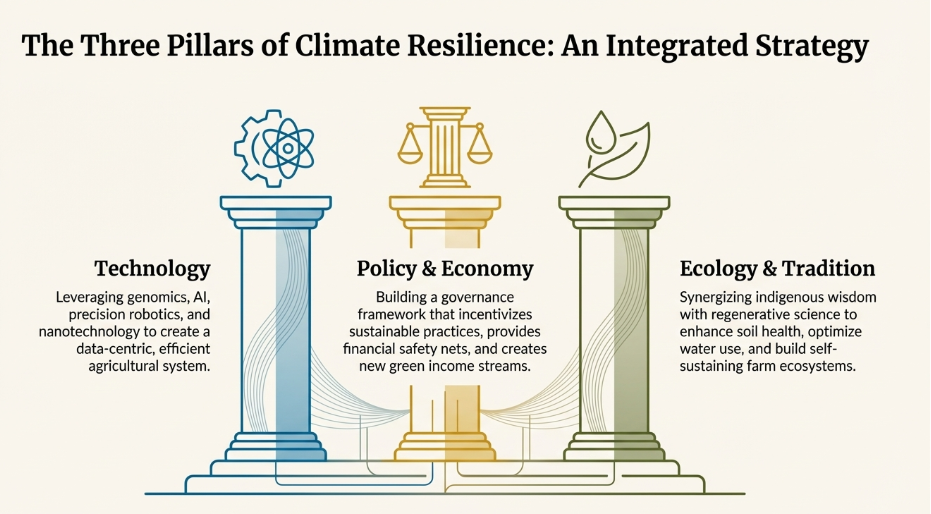
“Climate resilient agriculture integrates genomic analysis, biotechnology, and AI with adaptive policy to navigate climate change dynamics. This framework secures food supply and elevates farmer incomes, balancing economic growth with environmental conservation through data-driven best practices.”
NICRA 2.0 Roadmap: In October 2025, the Indian Council of Agricultural Research (ICAR) and CRIDA (Central Research Institute for Dryland Agriculture) unveiled a new roadmap for the National Innovations in Climate Resilient Agriculture (NICRA). The focus for 2025–2031 is to synergize NICRA’s village-level interventions with the Pradhan Mantri Dhan Dhaanya Krishi Yojana, aiming to scale climate-smart practices from 151 vulnerable districts to a national level.
BioE3 Policy Implementation: Following the approval of the BioE3 (Biotechnology for Economy, Environment and Employment) Policy, the government has designated climate-resilient crops as a strategic thematic area. This policy expedites regulatory pathways for non-GMO gene-edited crops (SDN-1 & SDN-2 categories) that are resistant to heat and salinity, moving them from labs to field trials.
CRISPR-Cas9 & SDN Technologies: Moving beyond traditional GM crops, India is now utilizing Site-Directed Nuclease (SDN-1 & SDN-2) technology. This allows for the editing of specific genes within a plant’s own DNA without inserting foreign genetic material, bypassing strict “transgenic” regulations.
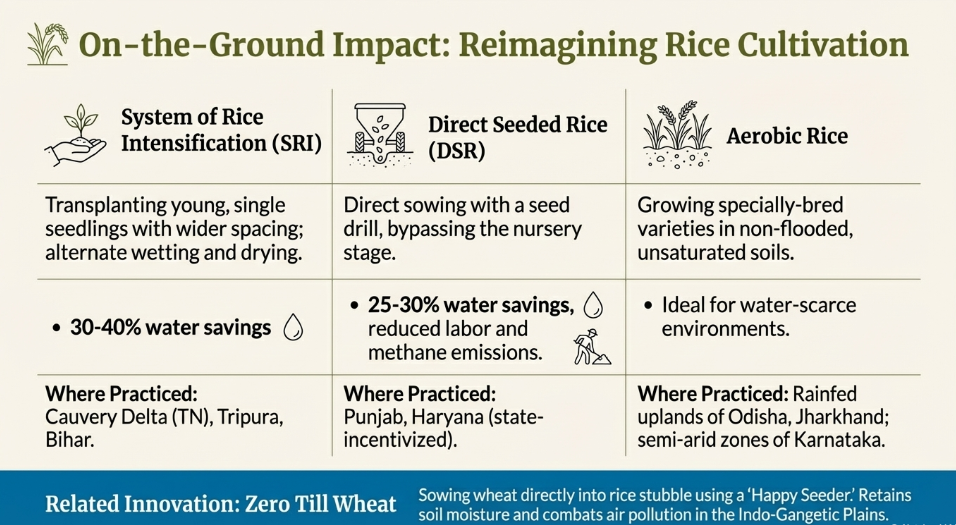
Applications And Examples: India’s MAS triumphs include Pusa Basmati 1979/1985 for water-saving DSR, CO 51 and CR Dhan 810 for flood-pest resilience, and HI 8840 wheat for heat-tolerant biofortification. Together, these varieties proof agriculture against climate volatility while ensuring nutritional security.
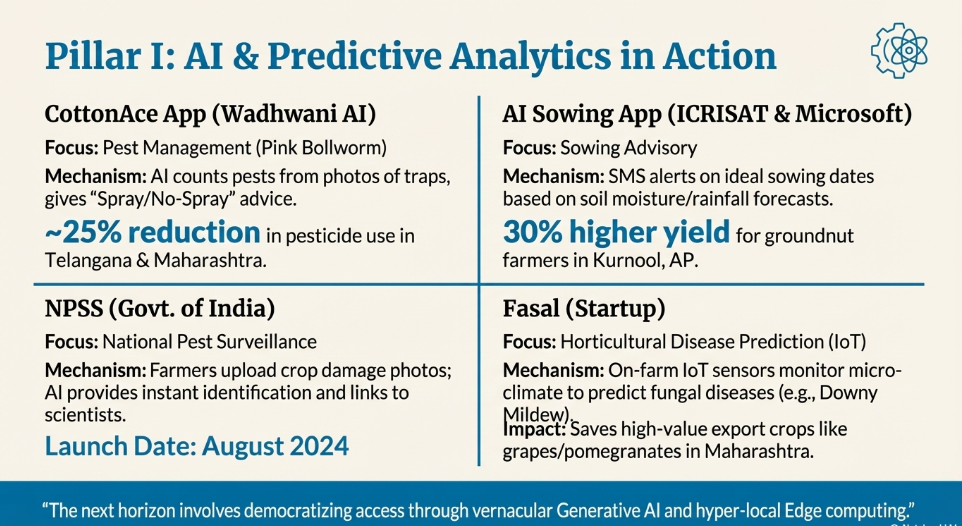
AI and predictive analytics revolutionize agriculture, using data to select optimal crops, and deploy preemptive surveillance/automated irrigation to mitigate risks, while forecasting supports national food security and farmer economic foresight.
“Integrating Precision Agriculture’s data-driven, site-specific optimization with automated robotics minimizes ecological impact while maximizing yields, fundamentally transforming farming into a resilient, data-centric science essential for climate adaptation.
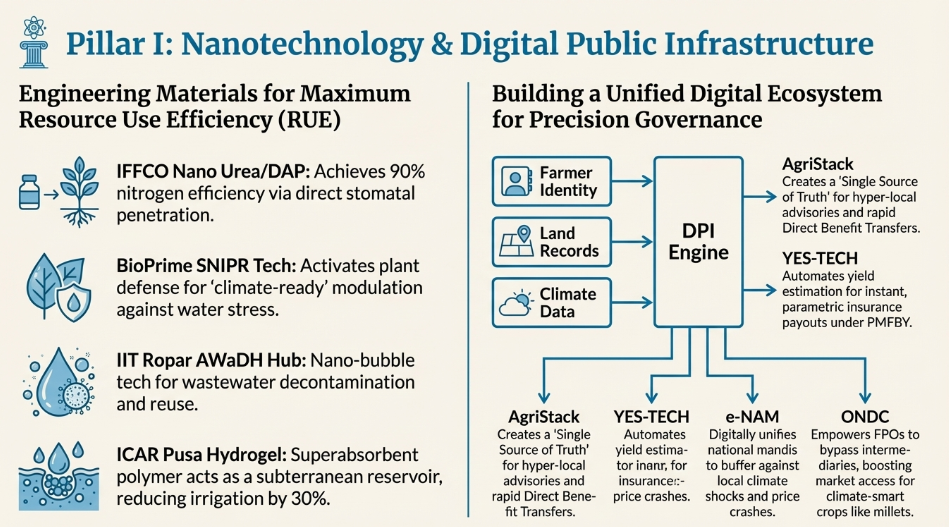
“Nanotechnology engineers materials at the atomic scale to create ‘smart’ delivery systems for nutrients and water. It maximizes Resource Use Efficiency (RUE) by ensuring inputs are released only when and where the plant needs them, minimizing wastage and environmental toxicity.”
“DPI in agriculture constructs a unified digital ecosystem—linking Farmer Identity (Registry), Land Records (Geo-location), and Climate Data (Risk)—to create an interoperable ‘super-highway’. This infrastructure enables real-time, data-driven targeting of subsidies, insurance, and advisories, shifting the system from generalized welfare to precision climate adaptation.”
Policy aims and objectives: Shifting the focus from “production at any cost” to “sustainable profitability,” integrating recent frameworks like BioE3 and established missions like NMSA to drive climate adaptation.
When adaptation fails and climate disasters strike, financial instruments prevent economic collapse.
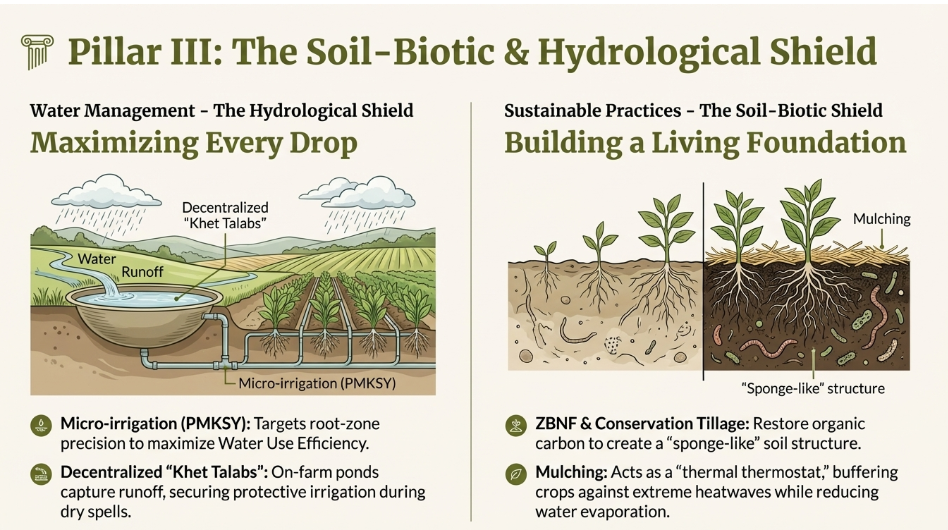
“Ecological agriculture synergizes indigenous wisdom with regenerative hydrology. It focuses on closing the nutrient loop and optimizing on-farm moisture to construct self-sustaining micro-ecosystems resilient to climatic extremes, prioritizing soil health over mere input intensity.”
The future of agriculture lies in an autonomous, circular ecosystem where genomic precision and AI-driven robotics converge with regenerative ecological practices. Guided by BioE3 and AgriStack policies, this transition will institutionalize environmental sustainability, transforming farms into carbon-sequestering hubs that guarantee global food security and economic prosperity amidst climate volatility.