
The intensifying Cyclone Montha, expected to make landfall along the Andhra Pradesh coast, has put eastern India on high alert. The India Meteorological Department (IMD) has warned of heavy rainfall, storm surges, and gusty winds along coastal Andhra and Odisha. Over 32 trains have been cancelled, and thousands of people are being evacuated from low-lying coastal areas. Such events not only highlight the increasing frequency and intensity of tropical cyclones but also underscore the urgent need for climate-resilient disaster management strategies.
A cyclone is an intense low-pressure system characterized by inward spiraling winds rotating counterclockwise in the Northern Hemisphere and clockwise in the Southern Hemisphere. Cyclones are large-scale weather systems that can extend hundreds of kilometers and last for days or even weeks.
In meteorological terms, a cyclone forms when warm, moist air rises from the ocean surface, creating an area of low pressure beneath. Surrounding air rushes in to fill the void, also heating and rising — setting off a self-sustaining convective system of towering cumulonimbus clouds, thunderstorms, and strong winds.
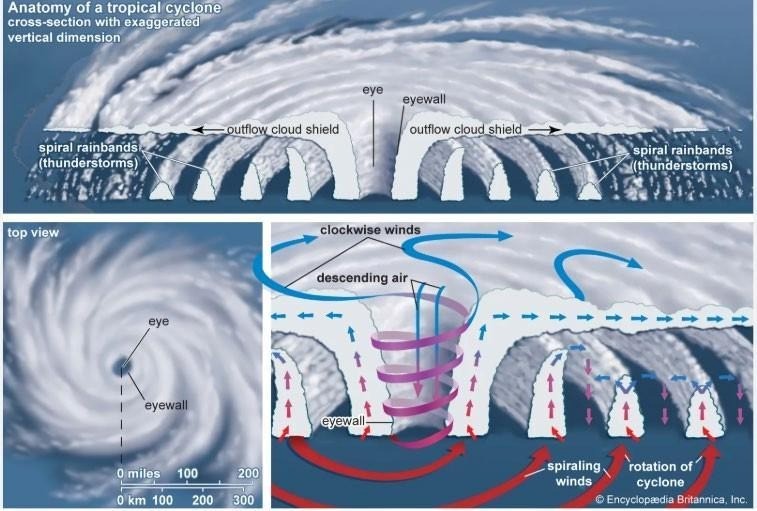
While the mechanisms remain the same, cyclones are known by different regional names around
the world:
The IMD classifies tropical cyclones in the North Indian Ocean based on wind speed:
The practice of naming cyclones was introduced to facilitate effective communication, tracking, and public awareness during weather forecasts and disaster management. Names make it easier for media, governments, and the public to remember and disseminate warnings efficiently.
Cyclones are named by regional specialized meteorological centers (RSMCs) and tropical cyclone warning centers (TCWCs) under the World Meteorological Organization (WMO).
There are six RSMCs worldwide, including:
significant storm.
This system ensures uniformity, cultural representation, and neutrality in global meteorological
coordination.
India’s east and west coasts have witnessed frequent cyclonic activity in recent years due to warming
crore people.
intensification of tropical cyclones in South Asia.
Cyclones have multidimensional impacts—environmental, economic, and social—often leaving long- term scars on coastal regions:
lines, ports, and communication networks.
contaminating freshwater sources and leading to saline intrusion in agricultural lands.
in interior regions, even far from the landfall point.
and human losses.
dengue) and water contamination.
India has developed a robust multi-tiered cyclone management system, combining forecasting, mitigation, and community resilience:
— sirens, SMS, and satellite alerts — to ensure timely evacuation and awareness.
Despite significant progress, several issues persist:
monsoon patterns are making cyclones more frequent, erratic, and powerful.
clearance increase vulnerability.
for fishermen and marginal farmers.
Cyclone Montha serves as a reminder that natural disasters are intensifying in a warming world, demanding proactive and science-driven governance. While India has emerged as a global leader in early warning and evacuation, true resilience lies in long-term adaptation, sustainable coastal management, and community-led preparedness.
The integration of climate action, technology, and local wisdom will ensure that India’s development trajectory remains both disaster-resilient and environmentally sustainable, turning every storm into an opportunity for stronger national preparedness.
| Factor of Differentiation | Tropical Cyclones | Temperate Cyclones |
|---|---|---|
| Location of Formation | Form between Tropics of Cancer and Capricorn (5°–30° latitude) over warm oceans | Form in temperate zones (35°–65° latitude) usually over land and oceans |
| Energy Source | Derive energy from warm ocean water (above 26.5°C) and latent heat of condensation | Derive energy from temperature differences between air masses (frontal systems) |
| Structure / Symmetry | Symmetrical, circular, compact system with a clear eye at the center | Asymmetrical, comma-shaped, often lack a distinct eye |
| Fronts Presence | Do not have fronts | Associated with cold and warm fronts |
| Seasonality | Most common in late summer and early autumn | Occur throughout the year but more frequent in winter and early spring |
| Size (Diameter) | Generally smaller (100–1000 km in diameter) | Larger (500–3000 km in diameter) |
| Wind Speed | Very high wind speeds (may exceed 220 km/h in “Super Cyclonic Storms”) | Moderate to high wind speeds, usually less than 120 km/h |
| Rainfall | Intense, short-duration rainfall causing flash floods | Moderate but persistent rainfall over a broad area |
| Life Span | Shorter (a few days to a week) | Longer (up to 15 days or more) |
| Areas Affected | Coastal areas, mostly tropical and sub-tropical regions | Both continental interiors and coastlines in temperate regions |