Mental health crisis in india, its impacts and way forward

  • Context: “ India’s mental health crisis threatens our demographic dividend, burdening society and jeopardizing future economic growth through rising untreated disorders and workforce productivity losses” 
  • India’s Suicide Statistics (ADSI 2023): Accidental Deaths and Suicides in India 2023 report.
    • Suicide is defined as death caused by self-directed injurious behavior with an intent to die as a result of that behavior.
    • Total suicides: 1,71,418 (↑ 0.3% from previous year)
    • WHO estimate: 16.3 deaths per 1,00,000 people.
    • States with most suicides: Maharashtra, Tamil Nadu, Madhya Pradesh, Karnataka, West Bengal (>40% total)
    • Student suicides: 13,892 in 2023 (8.1% of all suicides, 65% rise in a decade)

Causes Suicide:

  • Family problems: 31.9% (largest cause): Over 26–35% of Indian women report lifetime experience of abuse.
  • Illness: 19%
  • Substance abuse: 7%- NCRB 2023
  • Relationship/marriage-related: ~10% (combined)
  • Academic Pressure: Major cause cited in student suicides—over 2,248 exam-related suicide deaths in 2022 alone.
  • Social Stigma: Over 50% of Indians view mental illness as weakness or shame, driving a treatment gap of 70–92%—over 80% go without care.

Spatial analysis of Suicide: 

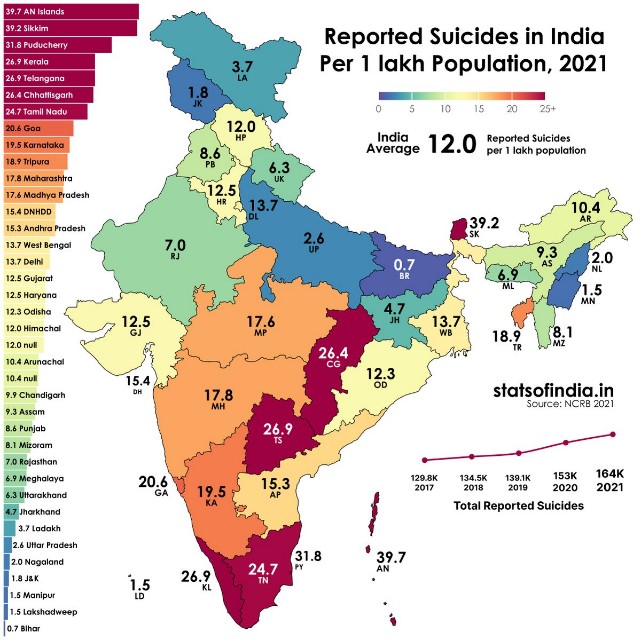
  • Highest suicide rates: Andaman & Nicobar Islands, Sikkim, Kerala
  • States with 40%+ deaths: Maharashtra, Tamil Nadu, Madhya Pradesh, Karnataka, West Bengal
  • Manipur (highest lifetime mental morbidity, despite small population)
  • Farmer suicide clusters: Maharashtra, Karnataka.
  • Best District Mental Health Programme (DMHP) coverage: Kerala, Tamil Nadu
  • Poor coverage & high service gaps: Northern, Northeastern, and rural states lag, with sparse infrastructure, personnel, and lack of awareness.

Demographics

  • Men: 72.8% of all suicide victims (shows gendered economic/social stress).
  • Young adults (18–30 years) account for ~35% of suicides.
  • Children/adolescents: Over 10% experience diagnosable mental health issues
  • Location: Higher prevalence in urban areas (13.5%) vs. rural (6.9%)
  • 70–92% of those with mental health disorders do not receive treatment.

Socio – Economic Impacts

  • The economic loss due to mental health conditions, between 2012-2030, is estimated at USD 1.03 trillion.
  • Annual employer loss: ₹1.1 lakh crore (due to absenteeism, attrition, burnout).
  • Escalate general healthcare expenditures for families and the system.
  • traps families in poverty, and limits social mobility.
  • Social exclusion: discrimination, isolation, and loss of social support.
  • Undermine academic performance, raise dropout rates, and reduce human capital formation.
  • Strain on the criminal justice system:  Higher rates of violence, substance abuse, and conflict challenge societal order and law enforcement.
  • Reduced life expectancy: People with serious mental disorders die 10–20 years earlier from chronic physical illnesses and suicide.
  • Hindrance to Sustainable Development Goals (SDGs): Poor mental health undermines progress on SDG 1: No Poverty; SDG 3: Good Health and Well-being; SDG 4: Quality Education & SDG 5: Gender Equality.

Mental Healthcare Challenges

  • Psychiatrists: 0.75 per 1,00,000 (WHO minimum: 1.7, ideal: 3)
  • Shortage: Psychiatrists, psychologists, social workers
  • Over 80% of districts lack even one government mental health professional.
  • Chronic Underfunding: Mental health receives 1.05% of the total health budget, with most states spending far less.
  • National mental health programme (NMHP) and District Mental Health Programme (DMHP) cover less than 50% of Indian districts.
  • Very few community-based rehab centers, especially outside major cities; most care is hospital-centric and short-term.

GoI: Policy and Action

  • National Suicide Prevention Strategy (2022): Aim to reduce deaths by 10%
    • Outcome so far: Suicides have increased.
    • Focuses on vulnerable populations, awareness, and crisis hotlines.
  • Mental Healthcare Act (2017):
    • Decriminalised suicide
    • Guaranteed right to mental health care
    • Mandated insurance coverage for mental illness treatment.
  • National Mental Health Programme (NMHP) (since 1982)
    • Integrates mental health with general healthcare.
    • Focus on early detection, community-based interventions, and destigmatization.
  • District Mental Health Programme (DMHP)
    • Expands mental health services to district levels.
    • Covers more than 50% of districts but faces implementation gaps.
  • Tele-Mental Health Assistance and Networking Across States (Tele-MANAS) (2022)
  • Manodarpan scheme: School-based psycho-social support remains largely inactive
  • ₹270 crore mental health budget: Mostly unspent
  • Mental health receives only 1.05% of India’s health budget, compared to 8–10% in Australia, Canada, UK.

CASE STUDIES AND GLOBAL BEST PRACTICES:

  • United Kingdom — Collaborative Care Model
    • Mental health nurses co-located with general practitioners (GPs) in primary care.
    • Stepped care and patient-centered approaches
  • Australia — Mental Health Nurse Incentive Program: integration of mental health into everyday program. 
  •  Uganda & South Africa — Multi-sectoral Community Forums: community led forums in different sectors driving rehabilitation.
  •  WHO’s Mental Health Gap Action Programme (mhGAP)
    • Training non specialists and creating a pool of mental health interventionists in countries like india.
  • Kerala as a role model state for addressing mental health crisis through effective district mental health programmes
    • Adopted community mental health model 
    • Early detection counselling to achieve stepped treatment.
    • Peer led education and awareness 
    • Wide district coverage and outpatient services.
    • Mental health care is free at the point of delivery, promoting universal access regardless of income.
    • leveraging non-specialist community/health workers, through training and supervision. 
  • Probable solutions and way forward
    • India must prioritize mental health, treating it as an emergency. This requires cross-ministerial task forces (health, education, agriculture, women/child welfare) and aiming for 3-5 mental health professionals per 100,000 people within five years. Counselling should be public infrastructure, with trained counsellors in every school, college, district hospital, and agrarian block. Public campaigns are needed to destigmatize help-seeking, share recovery stories, and normalize conversations about distress. For farmers, counselling must be combined with debt relief and livelihood support. In coaching hubs like Kota, mental healthcare needs to be continuous, institutional, and preventive. Emotional-support apps and AI tools must disclose privacy risks, have disclaimers, embed crisis-response redirections, and offer real-time access to licensed professionals.

Mental Health Concepts and Descriptions

Mental Health Concepts
Concept Description / Explanation
DALY (Disability Adjusted Life Year) Combined measure of years lost to illness, disability, or early death; quantifies overall disease burden.
Alzheimer’s Disease Progressive, irreversible brain disorder causing memory loss, confusion, and cognitive decline.
Dementia Group of conditions marked by decline in memory, reasoning, and thinking, impairing daily functioning.
Burnout Syndrome Prolonged work-related stress leading to emotional exhaustion, detachment, and reduced professional efficacy.
Stepped Care Treatment model where care intensity is matched to severity; escalates support only as needed.
District Mental Health Programme (DMHP) Government initiative integrating mental health into district-level public healthcare, focusing on early detection, treatment, and community awareness.

Mental Health Demographics and Key Statistics (India)

Mental Health Demographics in India
Demographic / Region Key Statistic or Fact
Prevalence 13.7% overall; 15% among adults; 2% experience severe mental disorders.
Urban prevalence 13.5%
Rural prevalence 6.9%
High-risk age group 18–30 years — accounts for approximately 35% of suicides.
Women Experience higher stress levels and greater vulnerability to domestic violence.
Men Represent 73% of suicide victims.
Treatment gap 70–92% of individuals with mental illness remain untreated.
States with highest suicide rates Andaman & Nicobar Islands, Sikkim, Kerala, Manipur.
States with large mental health burden Maharashtra, Tamil Nadu, Madhya Pradesh, Karnataka, West Bengal.
Best service coverage Kerala and Tamil Nadu.
Farmer suicide clusters Maharashtra and Karnataka.
PAY FEES