VB-G RAM G Act 2025

The Viksit Bharat-Guarantee for Rozgar and Ajeevika Mission (Gramin) (VB-G RAM G) Act, 2025

Contextual Understanding:

The Viksit Bharat – Guarantee for Rozgar and Ajeevika Mission (Gramin), or VB-G RAM G Act 2025, marks a transformative shift from the demand-driven MGNREGA to a supply-oriented, infrastructure-focused framework. By increasing the work guarantee to 125 days and introducing a 60-day “agricultural pause,” the Act seeks to balance laborer income security with farm labour availability, driving rural prosperity through high-quality, climate-resilient assets.


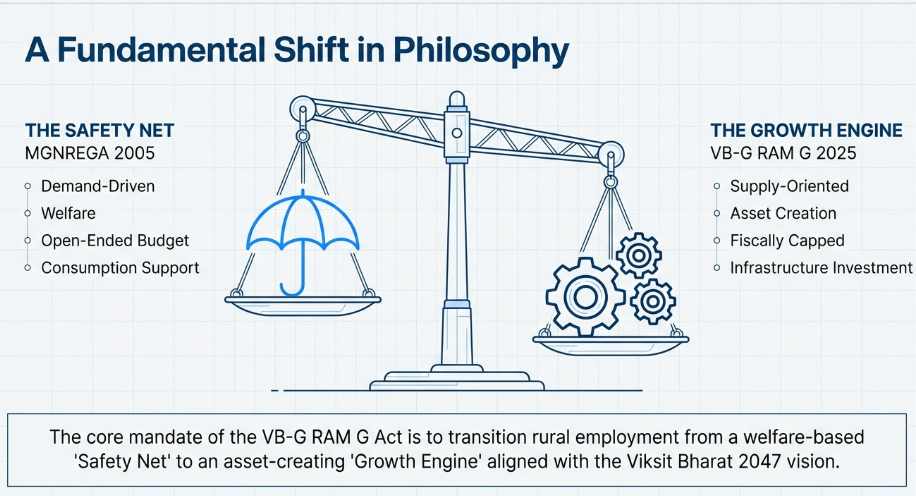
Core Mandate: To transition rural employment from a “Safety Net” (Welfare) to a “Growth Engine” (Asset Creation) aligned with the Viksit Bharat 2047 vision.
Key Features of VB-G RAM G Act, 2025:

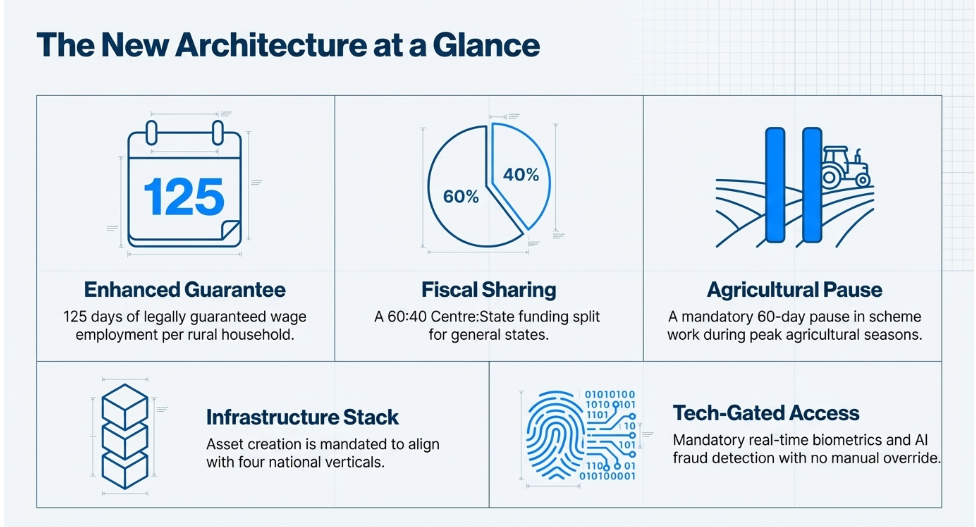
    1. Enhanced Guarantee:Legally guarantees 125 days of wage employment per rural household annually (up from 100 days).
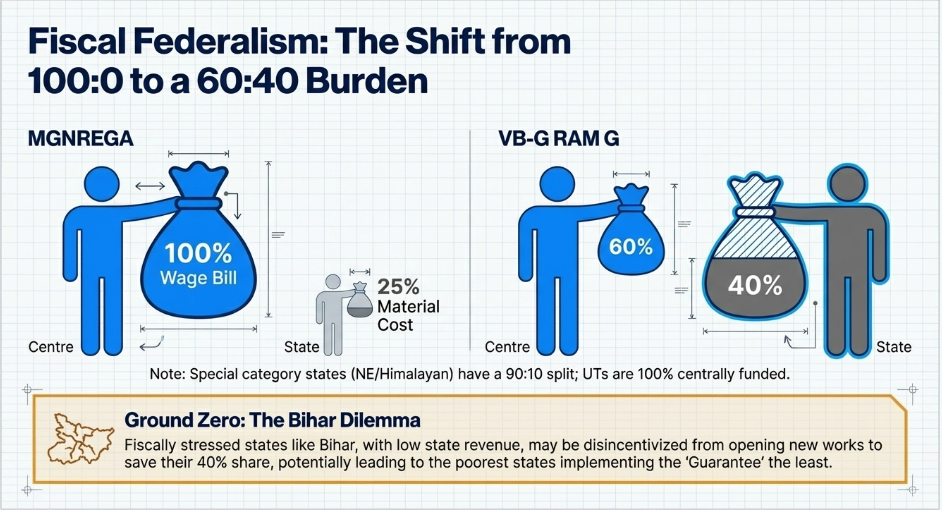
    2. Fiscal Sharing (60:40):Shifts from 100% central wage funding to a 60:40 split (Centre:State) for general states. NE/Himalayan states get 90:10; UTs get 100%.
    3. Normative Allocation:Replaces “demand-driven” open budgets with fixed annual allocations based on poverty and infrastructure gaps to enforce fiscal discipline.
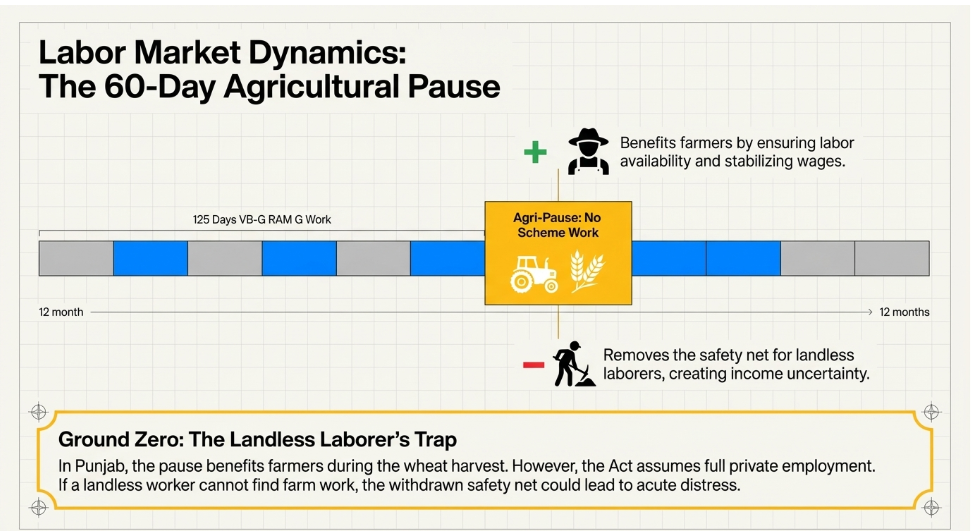
    4. Agricultural Pause:Mandates a 60-day “Agri-Pause” during peak sowing/harvesting seasons where no scheme work is allowed, ensuring labor availability for farmers.
    5. Infrastructure Stack:All assets must align with the National Rural Infrastructure Stack across four verticals:
      1. Water Security (Amrit Sarovars).
      2. Core Rural Infrastructure (Roads).
      3. Livelihood Infrastructure (Storage/Cattle sheds).
      4. Disaster Mitigation.
    6. Tech-Gated Access:Mandatory AI-based Fraud Detection and Real-time Biometrics for attendance; no manual override allowed.
    7. Planning Unit:Viksit Gram Panchayat Plans (VGPP) prepared by Gram Sabhas must integrate spatially with the PM Gati Shakti
  • Comparative Critical Analysis: MGNREGA (2005) vs. VB-G RAM G Act (2025)

    The Philosophical Shift: “Demand Driven” vs. “Normative Allocation”

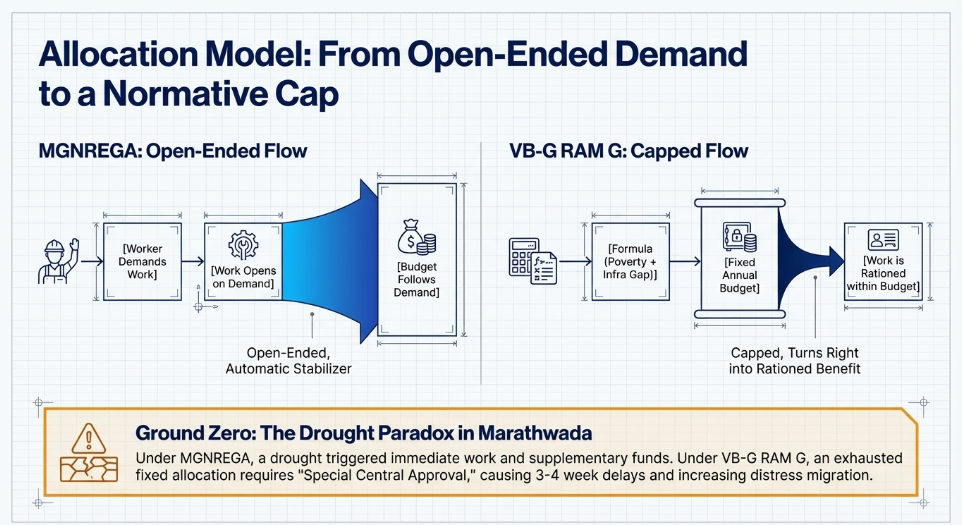
    MGNREGA is an “Open-Ended” safety net where the budget follows the demand, making it a critical automatic stabilizer during crises. Conversely, VB-G RAM G uses “Normative Allocation” based on a starting formula, which caps the budget and can turn a legal right into a rationed benefit during spikes in distress. Ground Zero Scenario (The Drought Paradox): Imagine a severe drought in Marathwada (Maharashtra). Under MGNREGA, high work demand led to immediate opening of works and later supplementary central funds. However, VB-G RAM G’s exhausted “Normative Allocation” by January required “Special Central Approval,” causing 3-4 week delays and increased distress migration.

    Fiscal Federalism: The “100:0” vs. “60:40” Conundrum

    MGNREGA’s Centre-funded 100% wage bill, with states covering only 25% of material costs, incentivized poorer states to maximize work. VB-G RAM G introduces a 60:40 (Centre:State) split for general states.

    Ground Zero Scenario (The Bihar Dilemma):

    Bihar, despite high rural poverty, has low state revenue (fiscal deficit). The 60:40 wage rule means the fiscally stressed state may discourage new works to save its 40% share, potentially leading to the poorest states implementing the ‘Guarantee’ least.

    Labor Market Dynamics: The “Agricultural Pause” (Section 6)

    MGNREGA is criticized by farmers for inflating wages and causing labor shortages during harvest. The VB-G RAM G scheme counters this by mandating a 60-day “Agri-Pause,” suspending scheme work during sowing/harvesting periods.

    Ground Zero Scenario (The Landless Laborer’s Trap):

    The VB-G RAM G Act, set in Punjab/Western UP during the April wheat harvest, significantly benefits farmers by stabilizing wages and increasing labour. However, a key critique is that the Act assumes full private sector employment; if a vulnerable, landless worker cannot find farm work and the government’s safety net is withdrawn during the “Pause,” they face starvation.
    Asset Quality vs. Local Autonomy

    MGNREGA: Prioritized Gram Sabha autonomy; assets, even if not technically durable (e.g., small mud roads), were built based on local demand. VB-G RAM G: Mandates alignment with the National Infrastructure Stack. Assets must be technically durable and fit into 4 verticals: Water, Roads, Livelihood, and Disaster.

    Ground Zero Scenario (The Asset Quality Trade-off):

    While “mud roads that vanish” are replaced by productive “Cattle Sheds” and “Check Dams,” a tribal hamlet’s request for a playground is rejected by the “National Stack” due to the “Economic Productivity” focus, sacrificing Gram Swaraj for technocratic efficiency.


    Technological Exclusion: “Digital Only” Governance

    MGNREGA: Had manual fallbacks (Paper Muster Rolls) when machines failed. VB-G RAM G: Mandates Real-time AI Biometrics and Geo-fencing for attendance. No manual overrides allowed to prevent corruption.

    Ground Zero Scenario (The Connectivity Divide):

    Due to intermittent internet at a remote Arunachal Pradesh worksite, the AI Face-Recognition app failed to upload attendance, resulting in workers being marked “Absent” and denied wages, illustrating “Digital Rights Exclusion” under VB-G RAM G.
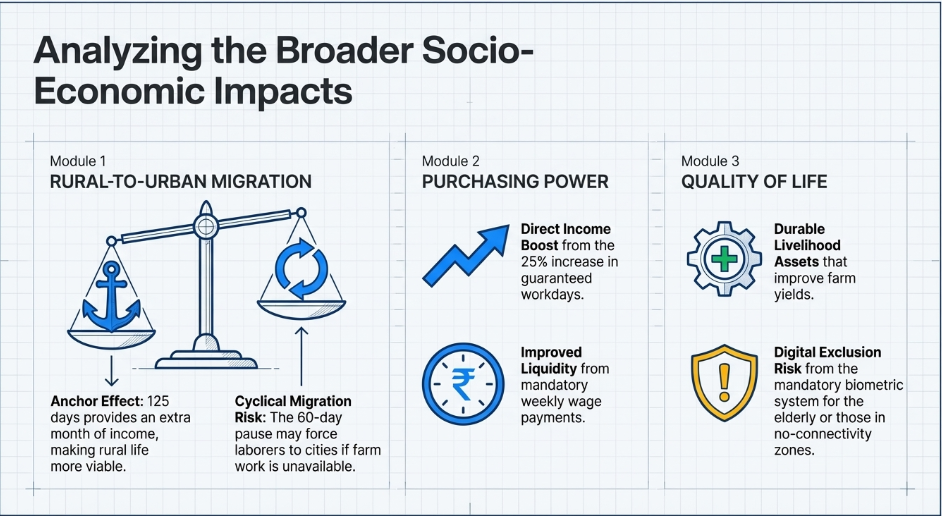
    Impacts Of The VG RAM G Act 2025

    1. Rural Development & Infrastructure Projects

    • Asset Durability:Unlike the often temporary assets of MGNREGA, this Act focuses on the Viksit Bharat National Rural Infrastructure Stack. Projects are integrated with PM Gati Shakti to ensure they meet national standards.
    • Thematic Verticals:Development is now siloed into four high-impact areas: Water Security, Core Infrastructure (all-weather roads), Livelihood Assets (warehouses/cold storage), and Climate Resilience.
    • Quality Control:The administrative budget has been raised from 6% to 9% to hire professional engineers and technical supervisors, moving from “pit-digging” to “engineering.”

    2. Rural-to-Urban Migration

    • The “Anchor” Effect:By increasing work to 125 days, the Act provides an additional month of income, making rural stay more viable for landless laborers.
    • Migration Risk:Critics argue that the 60-day agricultural pause might force laborers to move to cities during that window if they cannot find private farm work, potentially causing “cyclical migration” surges.

    3. Purchasing Power of Rural Adults

    • Direct Income Boost:A 25% increase in guaranteed days (from 100 to 125) theoretically increases the annual cash flow to the poorest households.
    • Weekly Payments:The Act mandates weekly wage cycles, solving the liquidity crunch laborers faced with MGNREGA’s often-delayed 15-day (or longer) payment cycles.

    4. Quality of Life of Rural Masses

    • Livelihood Security:Beyond just wages, the focus on “Livelihood Assets” (like community drying yards or ponds) helps small farmers improve their own yields.
    • Digital Inclusion vs. Exclusion:While real-time dashboards improve transparency, the mandatory Biometric & AI-based attendance creates a “digital barrier” for the elderly or those in shadow regions without connectivity.

    5. Role of Gram Sabha in Implementation

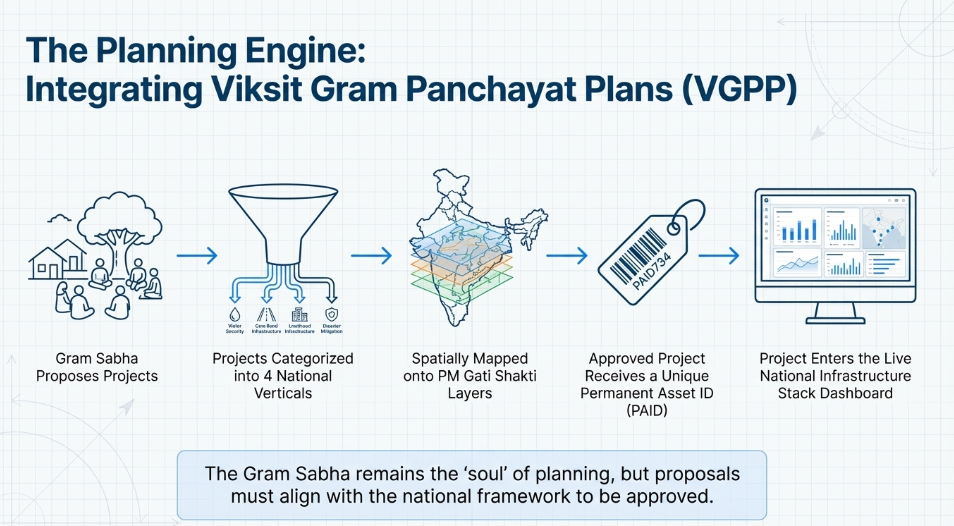
    • Decentralized Planning:The Gram Sabha remains the “soul” of the Act, responsible for drafting the Viksit Gram Panchayat Plans (VGPP).
    • Social Audits:The Act mandates a social audit every 6 months. The Gram Sabha has the power to flag “ghost assets” or wage theft directly to the National Steering Committee via a mobile app.

    6. Urban Version: Reducing Urban Unemployment

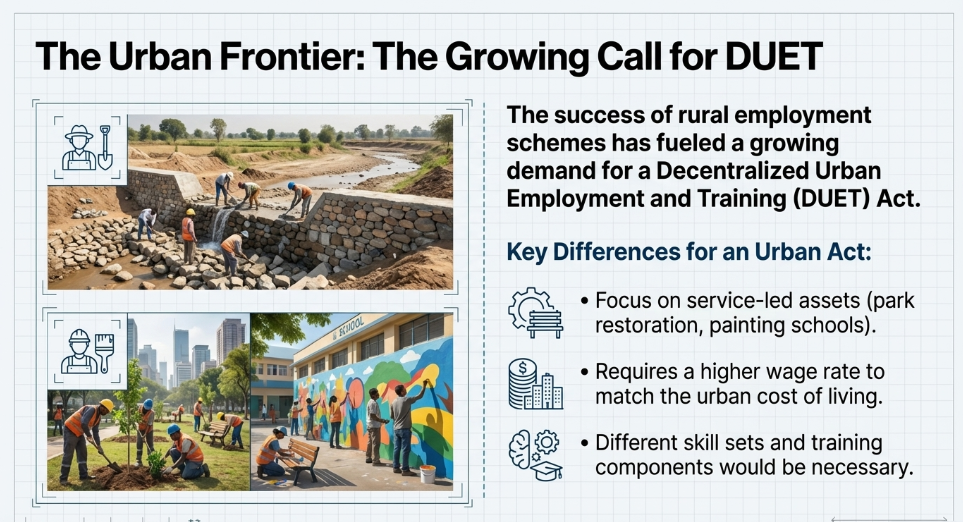
    • Demand for DUET:There is a growing call for a Decentralized Urban Employment and Training (DUET)
    • The Difference:Unlike rural work, an urban act would focus on service-led assets (restoring public parks, painting schools, urban forestry) and would require a higher wage rate to match the urban cost of living.

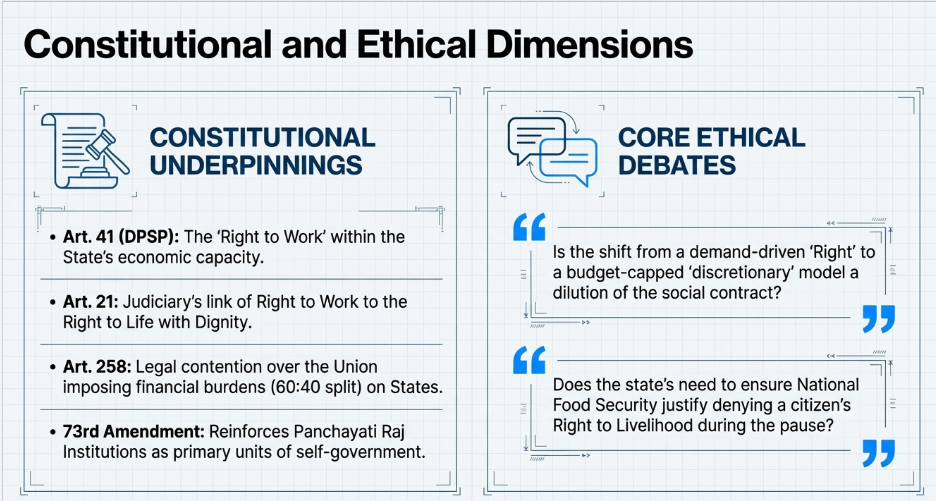
    7. Ethical Perspective

    • Rights vs. Discretion:Ethically, the shift from a “Right-based” (demand-driven) to a “Budget-capped” (supply-driven) model is debated. Critics call it a “dilution of the social contract,” while proponents see it as “responsible governance” that prevents fiscal waste.
    • The 60-Day Pause:It raises an ethical dilemma: Does the state have the right to deny a citizen work to ensure a “labor supply” for private farmers? It balances the Right to Livelihood against National Food Security.

    8. Articles of the Indian Constitution

    • Article 41 (DPSP):The primary driver, directing the State to ensure the “Right to Work” within its economic capacity.
    • Article 21:The Judiciary has often linked the right to work under such Acts to the Right to Life with Dignity.
    • Article 258:Currently a point of legal contention; it governs how the Union imposes duties and financial burdens (like the 60:40 split) on States.
    • 73rd Amendment:The Act reinforces the constitutional mandate of Panchayati Raj Institutions as the primary units of self-government.

    A multidimensional perspective on the 60 day agricultural pause: section 6 of VB-G RAM G Act 2025:

    Economic Dimension: Labor Market Efficiency

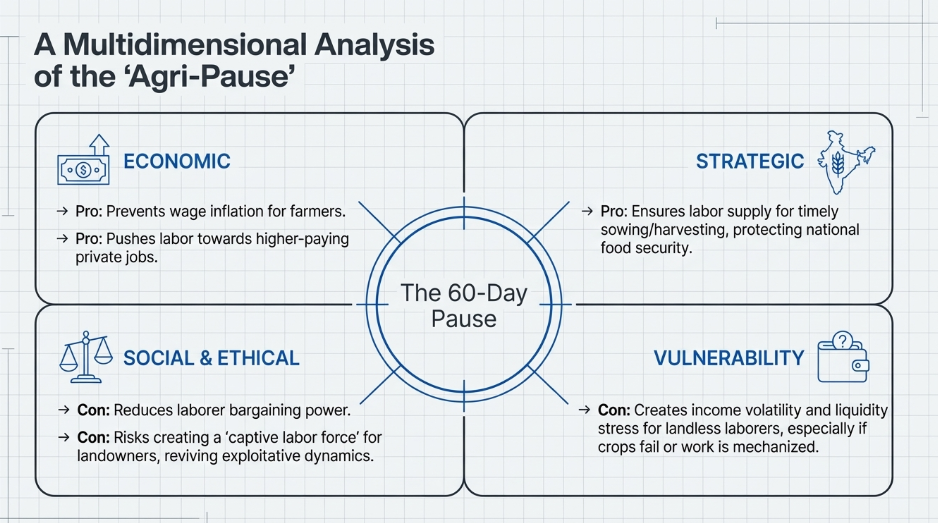
    • Preventing Wage Inflation:For farmers, the pause solves a long-standing grievance: “wage competition.” By stopping government work during peak seasons, it ensures that rural labor is available for private agriculture, preventing a spike in harvest costs.
    • Income Optimization:Proponents argue that market wages during harvest are usually higher than the government-fixed wage. By pausing the scheme, workers are “pushed” toward these higher-paying private jobs, theoretically maximizing their total annual income.

    Strategic Dimension: Agricultural Productivity

    • Food Security:Timely sowing and harvesting are critical for national food security. By ensuring a steady labor supply when the “window” for a crop is narrow (e.g., during the monsoon or before the first frost), the Act aims to protect overall agricultural output.
    • Crop-Cycle Alignment:The Act allows states to notify different dates for different agro-climatic zones, acknowledging that harvest time in Punjab differs from that in Tamil Nadu.

    Social & Ethical Dimension: Power Dynamics

    • Loss of Bargaining Power:Critics argue that the pause removes the “safety net” that allowed laborers to negotiate better conditions with landlords. Without the option of government work, a laborer is forced to accept whatever terms a local farmer offers.
    • The “Feudal Control” Argument:Civil society groups warn that this creates a “captive labor force” for large landowners, potentially reviving older, more exploitative labor dynamics in rural pockets.

    Vulnerability Dimension: Impact on the Landless

    • Income Volatility:Not all rural laborers are needed for every harvest. Landless households who are not hired by local farmers during the 60-day pause may find themselves with zero income and no government fallback during that window.
    • Liquidity Stress:If a crop fails or a harvest is mechanized (reducing the need for manual labor), the pause could leave millions of workers without work exactly when they need a shock absorber the most.

    Federal Dimension: State Discretion

    • Political Use:Since State governments notify the pause, there is a risk of the provision being used politically—either to appease the “farmer vote” by pausing work or to avoid using the state’s 40% budget share during those months.
    • Implementation Variation:We may see a “patchwork” of implementation where a laborer on one side of a state border has work, while their neighbor on the other side is in a “pause zone.”

    “Viksit Gram Panchayat Plan”

    Under the new law, a project is only approved if it originates from this bottom-up plan and is mapped onto the Viksit Bharat National Rural Infrastructure Stack, which is integrated with the PM Gati Shakti National Master Plan.
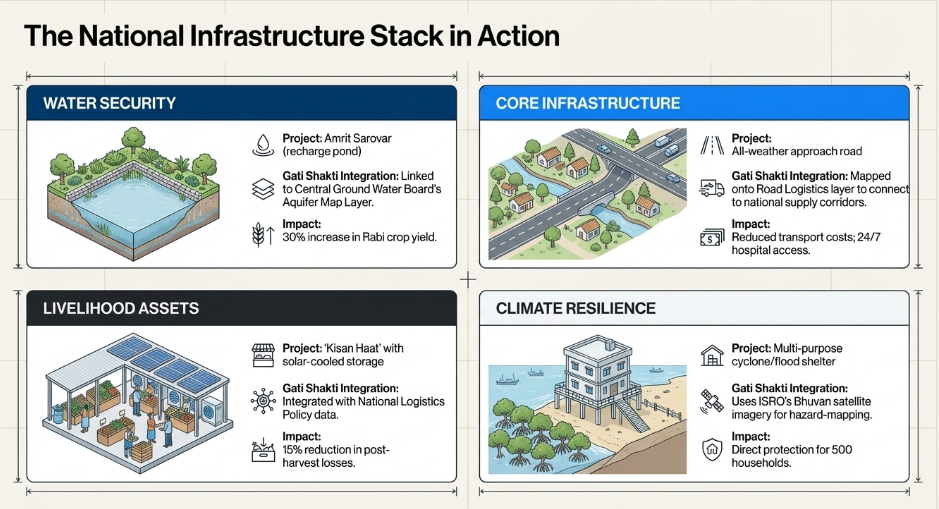
    Sample Viksit Gram Panchayat Plan (VGPP) 2026

    How the “National Infrastructure Stack” Works

    Every asset in the table above is no longer “invisible” after it is built. It becomes a digital data point in the National Infrastructure Stack:

    1. Unique ID:Each asset gets a Permanent Asset ID (PAID).
    2. Geo-Spatial Tagging:The road or pond is tracked via GPS; its progress is visible on a real-time national dashboard.
    3. Convergence:Because the project is on the “Stack,” other ministries (like Telecommunications) can see where a new road is being built and lay optical fibre cables at the same time, saving costs.

    The Role of the Gram Sabha

    In this new system, the Gram Sabha acts as the local “Board of Directors”:
    • Approval:No project enters the “Stack” without a resolution passed by the Gram Sabha.
    • Weekly Disclosures:Every Friday, the Panchayat must hold a “Transparency Meet” to show exactly how much of the 60:40 fund has been spent.
    • Maintenance:The Gram Sabha is now legally responsible for the “Asset Life Cycle”—ensuring that the road or pond is maintained long after the 125 days of work are over.


    CONCLUSION:

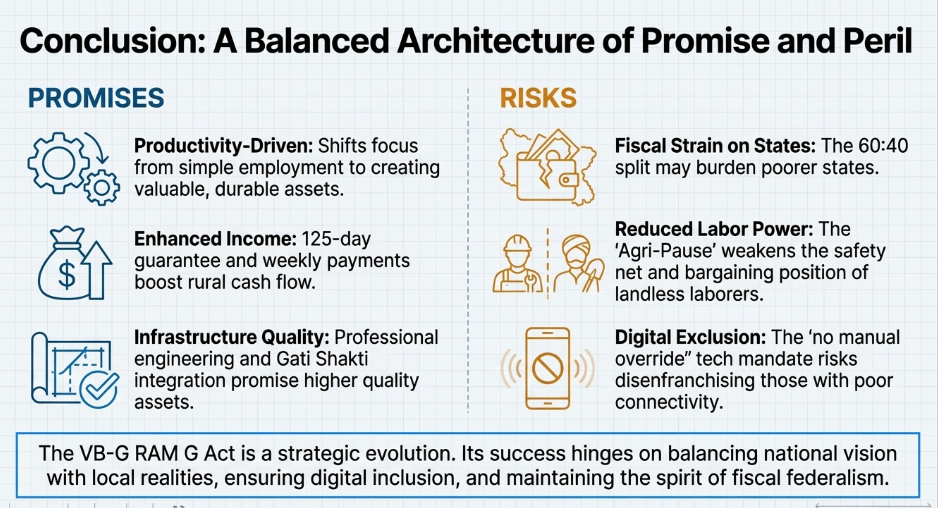
    The VB-G RAM G Act 2025 marks a strategic evolution from a pure safety net to a productivity-driven mission. While the 125-day guarantee and infrastructure focus promise enhanced rural incomes and durable assets, the 60-day agricultural pause and 60:40 funding split pose risks of reduced labour bargaining power and fiscal strain on states. Moving forward, success depends on ensuring digital inclusion, maintaining state-level financial flexibility, and rigorously auditing asset quality to ensure long-term rural resilience.

    PAY FEES